
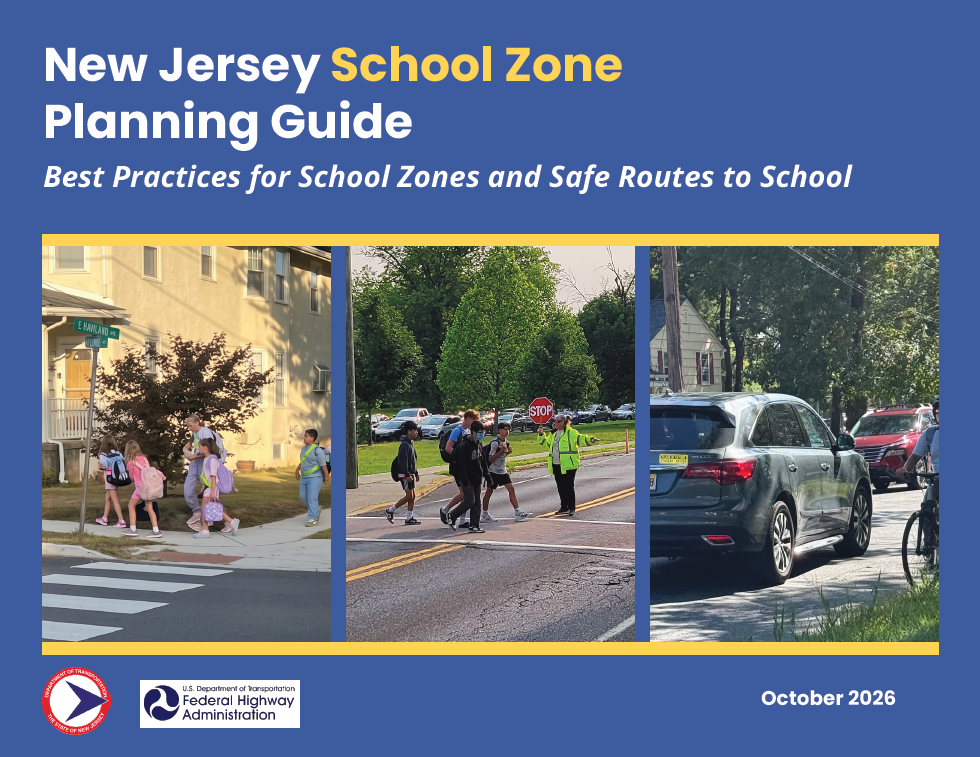
This updated New Jersey School Zone Planning Guide provides a comprehensive one-stop resource for school zone planning, roadway design, and community engagement. It captures significant changes and innovations since the original publication in 2014. The Guide’s purpose remains the same: to support safer and more accessible travel for students whether they walk, ride a bicycle, use mobility devices, take transit or a school bus, or commute by car. This Guide was prepared for the New Jersey Department of Transportation by NV5 and Toole Design.
While roadway safety has always been part of the New Jersey Department of Transportation (NJDOT)’s core mission, the adoption of Target Zero in 2024 established a renewed commitment and a new metric for measuring progress towards the goal of eliminating traffic fatalities and serious injuries on New Jersey roads. School zones warrant particular attention within the Target Zero framework because they concentrate children, some of the most vulnerable road users, during predictable but operationally complex arrival and dismissal periods. The New Jersey School Zone Planning Guide presents strategies and solutions based on the most recent innovations, performance data, and regulatory changes. Implementing improvements and innovations will require coordination among school districts, municipalities, counties, the state, and the public to address safety both on school property and along the routes students travel to and from school.
The national Safe Routes to School context has also changed. In 2014, federal Safe Routes to School activities were limited to students in kindergarten through eighth grade; eligibility has since expanded to include students through grade 12. An update is needed to address the differing travel patterns, independence, trip distances, multimodal needs, and roadway contexts associated with middle and high school students, in addition to those of elementary school students.
Finally, the professional reference framework available to planners and engineers has evolved. The current Manual on Uniform Traffic Control Devices (MUTCD) includes new and revised national standards for traffic-control devices on public streets and highways, including devices used in school zones. Updated Accessible Design Guidelines for Pedestrian Facilities in the Public Right-of-Way (PROWAG) also reinforce the need to provide routes and crossings that are usable by people with disabilities. And a growing library of guidance from organizations such as AASHTO and NACTO provides new and updated data-driven, context-sensitive tools to improve roadway safety for people of all ages and abilities.
Read the full guide: New Jersey School Zone Planning Guide (2026)